I have had a few people ask about evergreen content lately, so here is the honest version, with the numbers from a channel we manage.
Evergreen means videos that are not built for browse traffic. They are built for search. Nobody calls it exciting, because it is not. It is called the long game. Most YouTubers chase the short-term browse spike, looking to make money out of virality, and yes, that is certainly one way to do it. The other way, which most people never try, is building a channel of videos that take time to find their audience and then keep finding it, because the topic is evergreen rather than news-based. Usually educational. Usually answering a question people will still be typing into YouTube in three years.
Two videos, same channel
Here are two screenshots from one of the evergreen channels we manage. It is an educational channel in the travel jobs niche. The first video was posted a little over two years ago. The second was posted about three months ago.
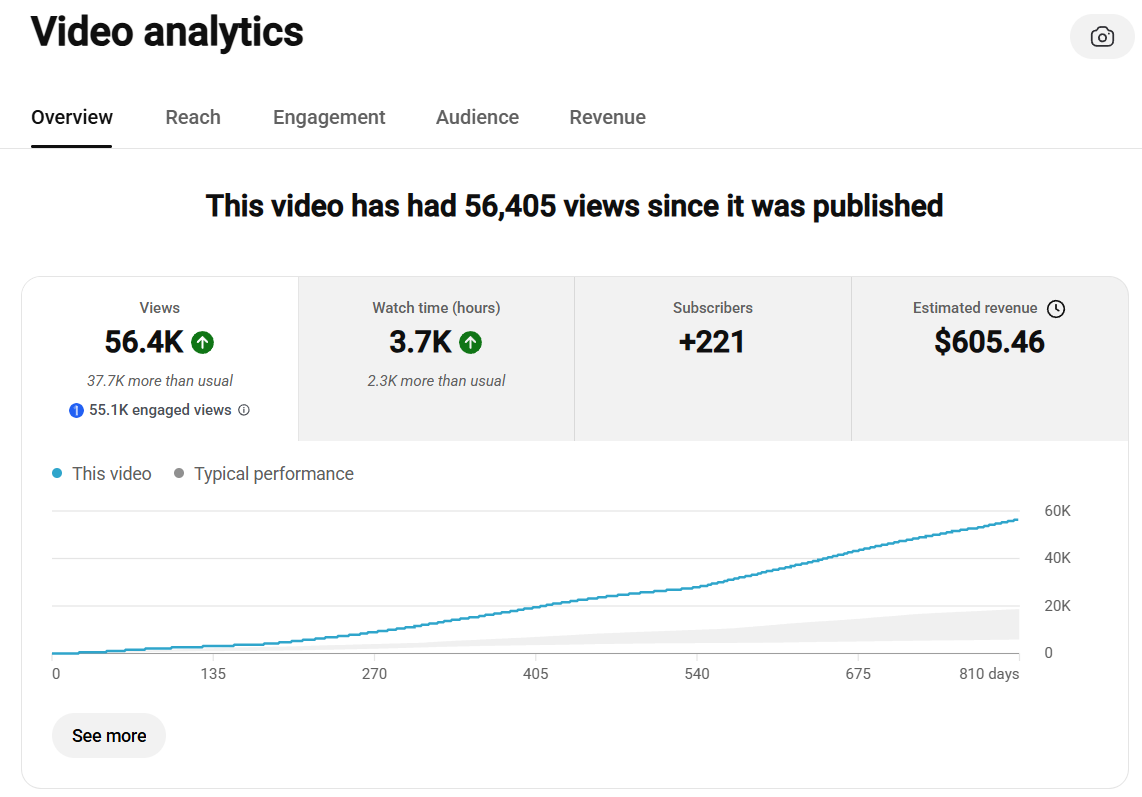
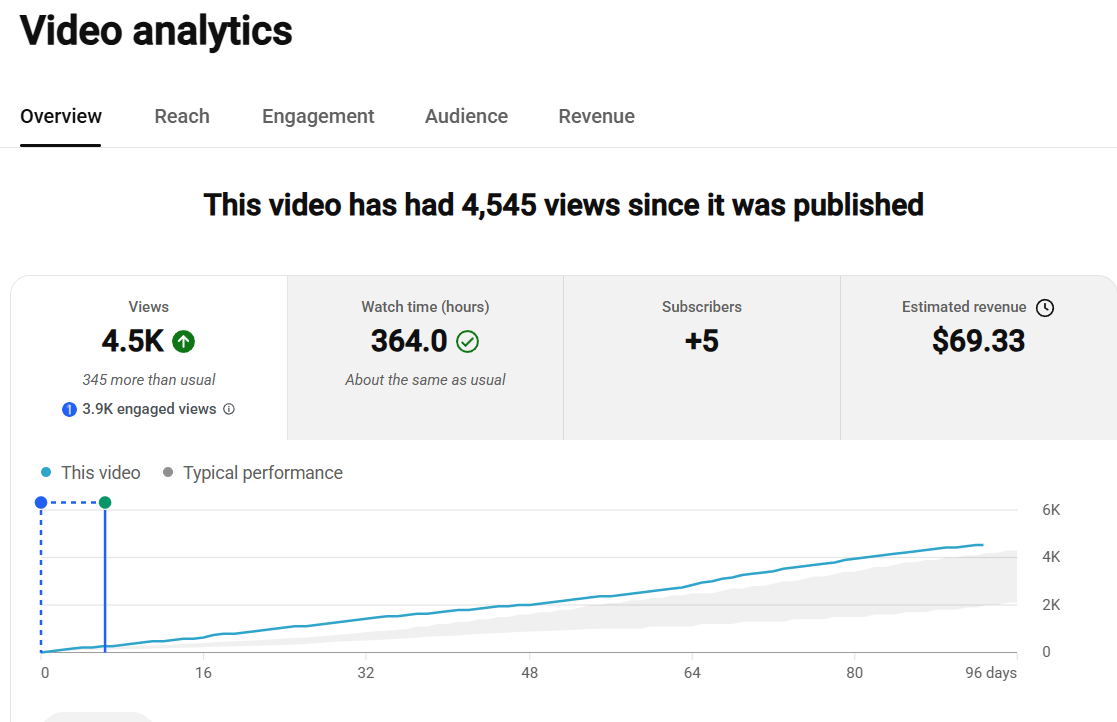
Neither of these went viral. Neither of them ever will. Look at the shape of the lines instead: they start slow, and they build, and they do not stop. The older video is 810 days old and still adding views every day. The newer one is doing the same thing at 96 days, already sitting above the grey typical band. That is what evergreen looks like. Not a spike. A slope that never flattens.
What one video is worth
On this channel, each video, once it has built, makes close to $300 a year in ad revenue. Not $300 once. $300 a year, for as long as the content stays relevant. The two videos above are running at roughly $270 a year each, and the older one shows no sign of slowing down.
A video on this channel costs us around $50 to make. So a $50 video pays for itself inside its first year and then keeps paying. That is the whole argument, and most people stop reading before they do the maths on it.
Now do the maths
Two videos a week is 104 videos a year, which is about $5,200 in production cost. A new channel takes four to five months to get monetised, so year one is the investment year: the first videos earn nothing for a while, and everything is still ramping. Call it around $12,000 in and roughly $7,000 net by the end of year one.
Now keep posting two a week. By the end of year two you have 208 videos. The first 104 earn a full year, the second 104 earn about half a year on average. That is around $47,000 in against $5,200 out, roughly $41,000 net for the year.
End of year three: 312 videos, around $78,000 in, roughly $73,000 net. You get the picture. Nothing about the videos changed. The library got bigger, and every video in it is still working.
Why almost nobody does this
Because the first four months look like failure. A search-built video at day seven has a few hundred views and no comments, and the browse-built video from the channel next door has fifty thousand. So people rewrite, or delete, or change niche, at exactly the point where the slow line was about to start climbing.
The other reason is that evergreen has to be built on purpose. The topic has to be something people search for rather than something that is trending. The title has to match how they search. The script has to answer the question properly, because search viewers arrive with a problem and leave the moment it is not being solved. None of that happens by accident, and none of it is the same as the advice for chasing browse.
Go and look at your own
Open any video of yours that is more than six months old and look at the shape of the views line. If it flattened after the first week, it was a browse video and it is finished. If it is still climbing, however slowly, you have an evergreen video and you should make ten more like it. That is the decision: which kind of channel are you actually building? The two need different topics, different titles and different scripts, and the biggest mistake we see is a channel trying to be both and ending up neither.