There are a lot of videos going around about the February change, and most of them get the shape of it wrong. Here are the facts from YouTube’s own announcement and help pages, then the two sums that tell you what it means for your channel.
What YouTube announced
On 10 August 2026 the YouTube blog published the change. It takes effect on 1 February 2027. From that date a channel applying to earn from ads needs 8,000 qualified watch hours in the last 365 days, or 20 million qualified Shorts views in the last 90 days, and still needs 1,000 subscribers. Until 31 January the bar is 1,000 subscribers plus 4,000 watch hours or 10 million Shorts views.
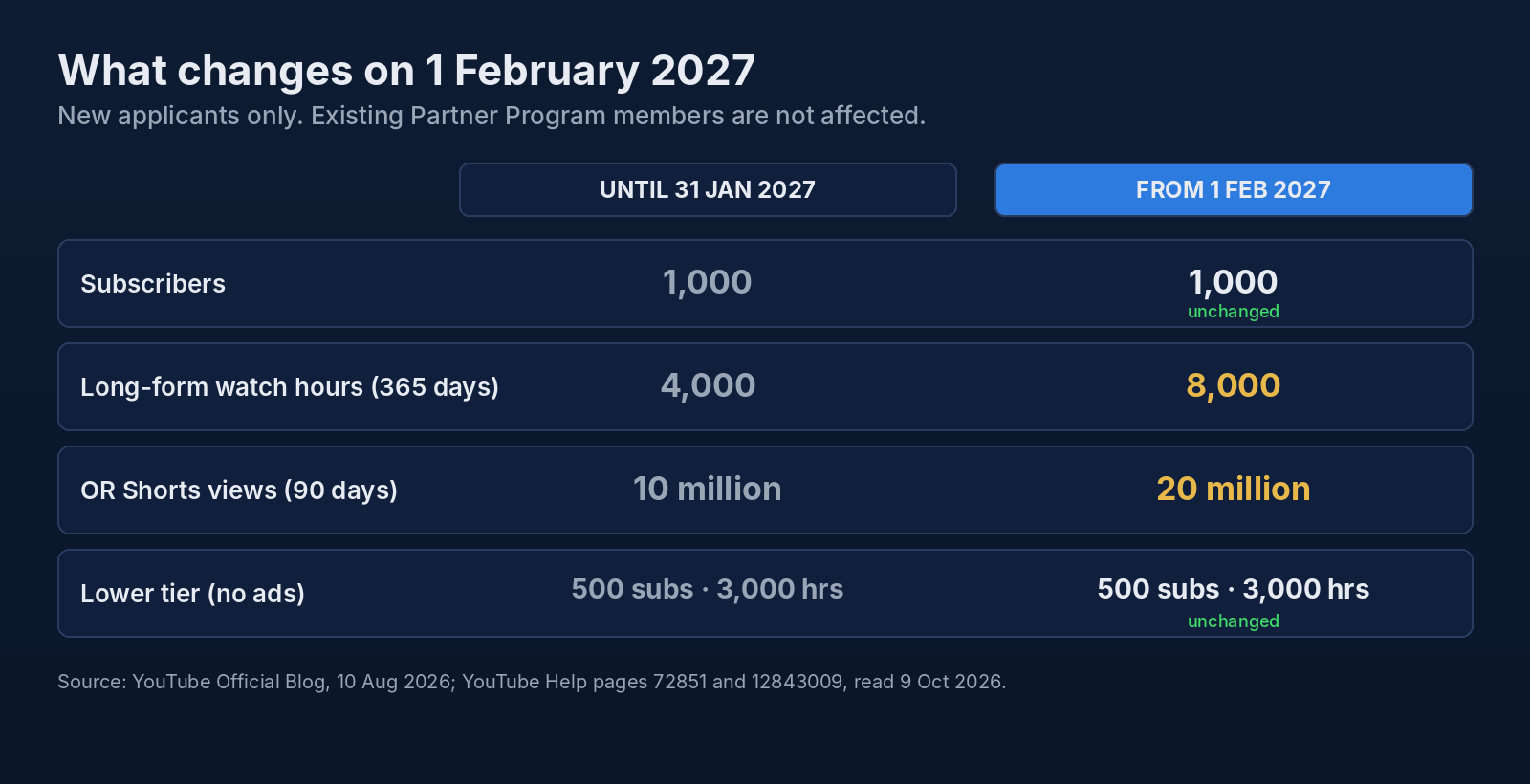
Three things did not change. The 1,000-subscriber requirement is the same. The lower tier is the same: 500 subscribers, three public uploads in the last 90 days and 3,000 hours still unlocks memberships, Super Thanks and Shopping, and never unlocked ads. And channels already in the Partner Program keep their place. The blog says the update will not affect creators already in the programme, with no end date given.
Only watch time on public long-form videos and public archived livestreams counts. Shorts-feed watch time, unlisted and private videos, deleted videos and views bought through ad campaigns do not count, and never did. The two routes do not add up either: five thousand hours plus fifteen million Shorts views qualifies under neither. You cross one bar or the other, in full.
The deadline is December, not February
YouTube’s help page says a review typically takes about a month, and that delays are possible. Your counts can fall during review without affecting the application. What neither the announcement nor the help pages say is how an application lodged before 1 February but still under review on that date will be judged. There is no published transition rule, so do not rely on one.
A rejection in January is expensive too. YouTube’s rule is that you can appeal within 21 days, or keep uploading and re-apply after 30 days, with a 90-day wait after a second rejection. Either way you land on the far side of 1 February and the new bar.
So the target is to cross 1,000 subscribers and 4,000 hours by the last week of December and apply the same day. From the middle of October that is twelve weeks.
The two sums
Most of the videos frame this as a race for watch hours. For most channels that is the easier half. Run both sums for your own channel before you plan anything.
Sum one, views to hours. Watch hours are views multiplied by average view duration, divided by sixty, so 4,000 hours is 240,000 minutes of watching. A fifteen-minute video where viewers stay for forty per cent on average gives a six-minute average view. At that rate 40,000 views gets you 4,000 hours. At a ten-minute average view it is 24,000. One video that lands in the suggested feed can do it on its own.
Sum two, views to subscribers. We found no subscriber-conversion benchmark published by YouTube, so the only data is what people have measured themselves. The largest sample we found is from OverseerOS, 76 channels published in September 2026, which they say plainly is not a random sample. The median channel gained 1.91 net new subscribers per 1,000 views. The top quarter 4.57. The top ten per cent 7.66.
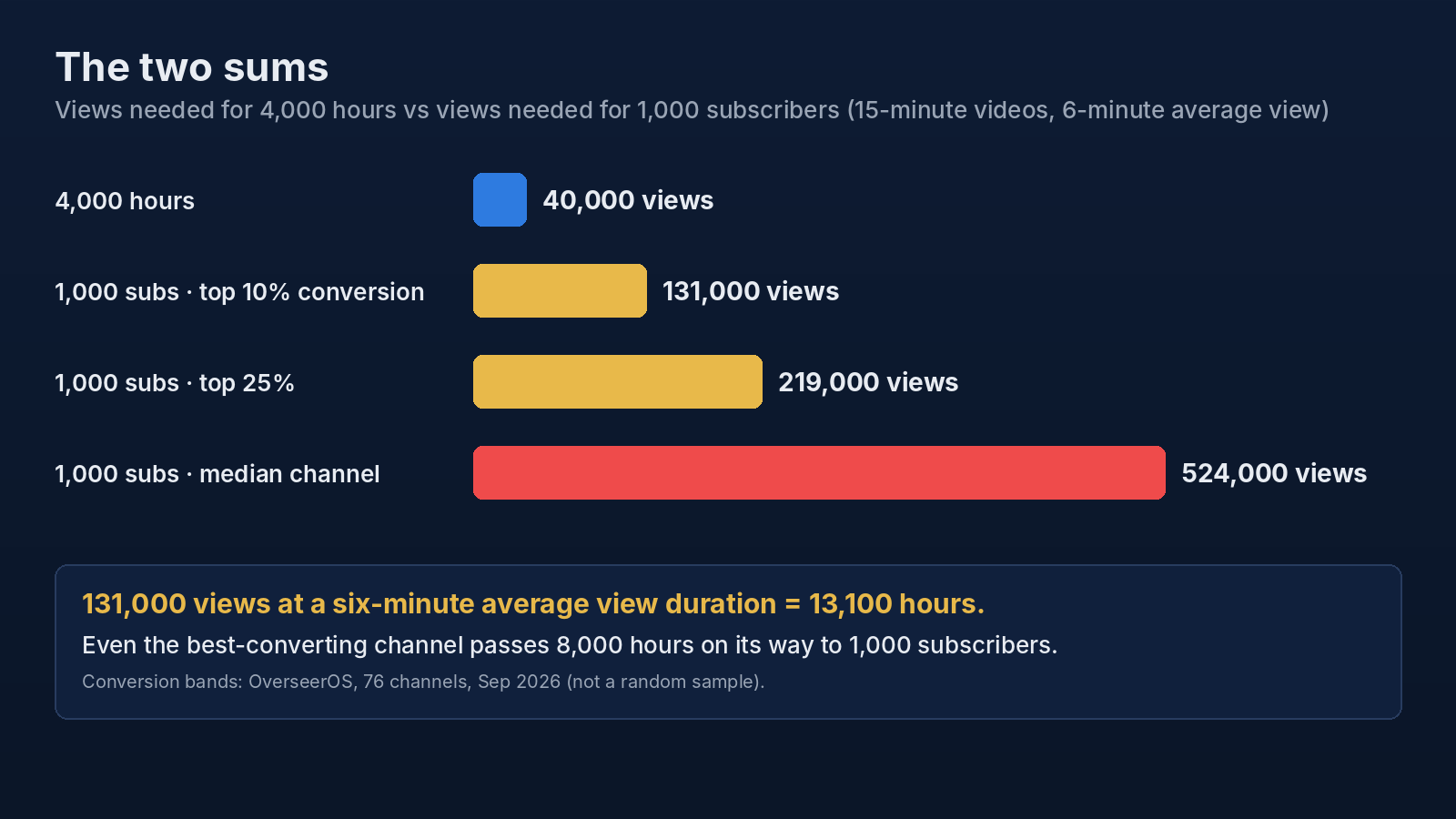
At the median that is about 524,000 views for 1,000 subscribers. In the top quarter about 219,000. In the top ten per cent about 131,000. Even the best-converting channel needs more than three times the views for its subscribers than for its hours, and those views bank hours on the way: 131,000 views at a six-minute average view is 13,100 hours, past the new 8,000 bar as well as the old one.
What this means for your channel
If you make long-form videos of ten minutes or more, the hours arrive with the subscribers. Subscriber conversion is the job, and it is the one thing YouTube did not change. A channel converting at 5 per 1,000 instead of 2 needs less than half the views, which is why every strategy worth your time between now and December is about moving that number rather than chasing views.
If your channel is mostly Shorts the picture flips. Kapwing published a test where a channel reached 1,000 subscribers in 157 days almost entirely through Shorts and banked only 37 watch hours. Shorts can get you the subscribers; long-form gets you the hours.
We have put the whole thing in a free report, 1,000 Subscribers Before February: the facts above, seven ways to move the conversion number, the twelve-week run sheet dated from this week, the weekly scorecard and the self-audit before you apply. It is for any YouTube channel, faceless or not. Get it at facelessconsole.com/1000subs.